

Baking Blocks: Soufflé pt. 4
A zingy lemon soufflé for spring days

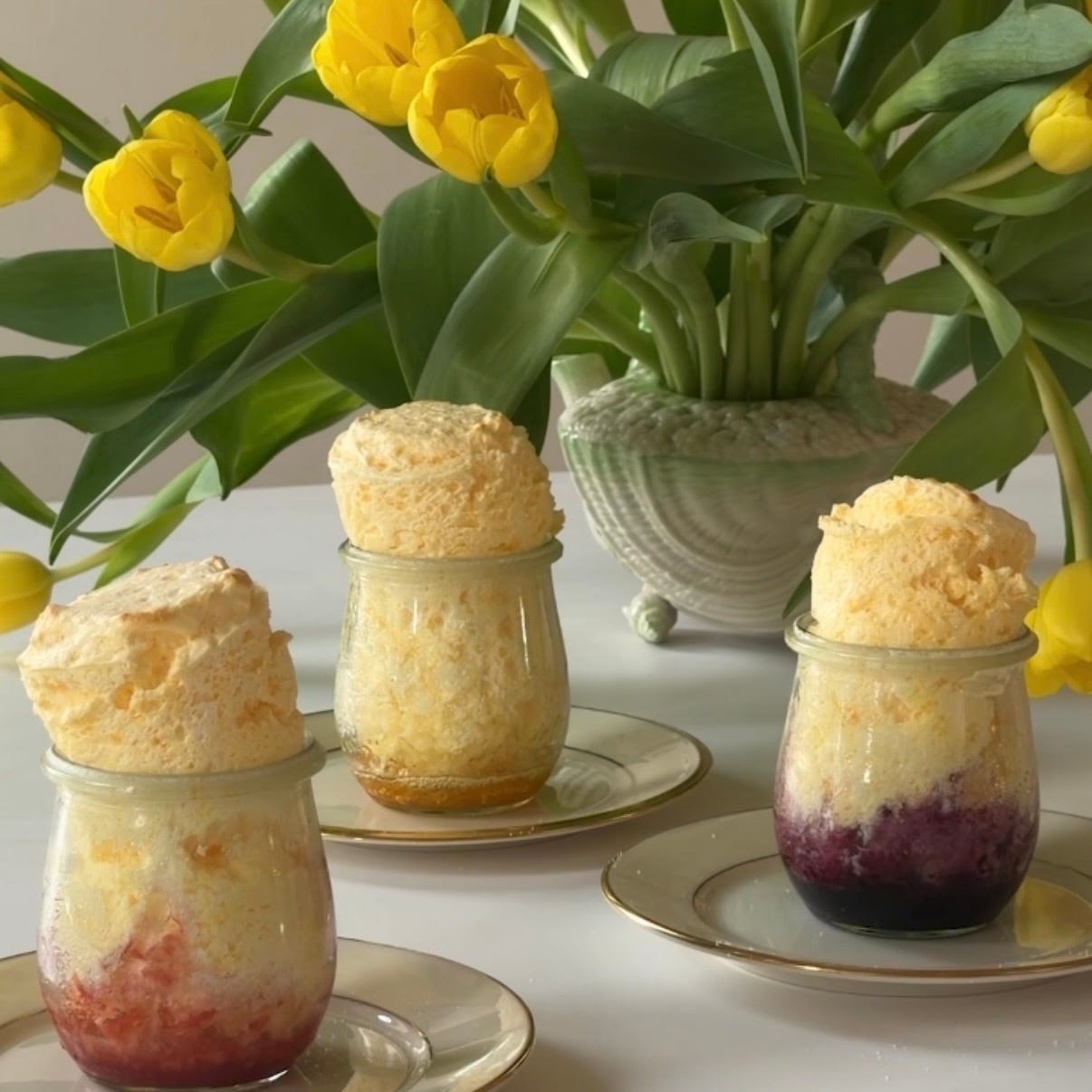
Now that spring is here–the days are getting brighter and longer, the weather is still a bit nippy, and the sunlight is becoming a warmer shade of yellow–there is one soufflé on my mind that will usher in the season best: a bright lemon soufflé over a punchy coulis.
I love how the addition of just one ingredient, a lemon (zest and juice), can transform a vanilla soufflé base into something so much brighter. While lemon can make a soufflé extra delicious, it can also absolutely ruin soufflé. Too much lemon and the acid overworks the starch making it gummy (my first test was ultimately a lemon curd folded with whipped egg whites – it currently holds the #1 spot for worst baking failure of ‘26). I worked my way down, 5g at a time over a half dozen tests, and finally landed at 25g. This amount of lemon is the sweet spot, not changing the texture too much, but still adding a bit of lemon zing.
To brighten the soufflé up a bit more, I added a coulis/compote underneath, and it is fantastic (just like the Salzburger soufflé). A raspberry or strawberry coulis transforms this into a soufflé dessert version of pink lemonade, and baking it over a blueberry compote or kumquat marmalade beautifully amplifies those tart, citrusy notes (my and Théos’ preference).
I couldn’t help but match these springy-zingy soufflés with the lightest-bounciest dress in my closet. I love how all the color blocks of yellow, red, blue, and orange match the brightly colored compotes and souffle. The dress was a major score back from February’s trip to Tokyo. I found some gorgeous second hand alternatives here, here, and here, if you love Pleats Please as much as I do.


Makes 4 6oz soufflés (underfilled or makes 3 + a little extra when properly filled)
Lemon Soufflé:
Butter and sugar for the ramekins
Custard:
115g whole milk
1 large lemon (zest + some of the juice)
10g cornstarch
4g all-purpose flour
10g sugar
1/4 tsp Diamond Crystal Kosher Salt
35g egg yolks (~2 large)
6g butter
3g vanilla extract optional
Egg Whites:
50g powdered sugar
120g egg whites (~3 large) room temperature
1/4 tsp vinegar (or substitute with lemon juice if you have more)
Optional Compote/Coulis:
60-80g of any of the following:
Strawberry coulis (use the Salzburger recipe but eliminate the water and liqueur + reduce the sugar to 60g)
Blueberry compote from the Blueberry Crumb Pancake recipe (cut the recipe in half and replace the maple syrup with sugar)
Tools:
Hand mixer or stand mixer
4 ramekins for baking, or jars (mine were 6 oz, but you could use even smaller ramekins or make 1 soufflé in a large ramekin – just note it will change the bake time)
You can find ingredient information and tips for conversions on my conversion cheat-sheet page. If you have any further questions, please feel free to leave a comment!
Prep!
Make the coulis/marmalade/compote of your choice (see links in the ingredient section).
Preheat your oven to 400f, and place an oven rack on the lowest rung, leaving ample room on top for the soufflé. Take a baking sheet and place it in the lower rack of your oven. Grab a small baking tray or cake pan (8x8 or 9x9), fill it with 3 cups of water, and place it at the bottom of your oven. This will add steam, leading to a more even cook on the soufflé.
Take your ramekins and butter the sides (I usually use a butter wrapper, but for a more traditional method, melt the butter and brush it upwards). Then add some sugar and turn the cup to coat all of the sides. Tap out any excess. Add your compote/coulis into the bottom of each ramekin, dividing it equally. Set the ramekins aside in a cool place so the butter doesn’t melt while you prepare the soufflé.
For the jars: I found that the souffle liked to rise so high it would spring out of the jars. To stop this from happening you can omit the butter and sugar entirely, or you can butter and sugar and just cross your fingers. (I usually use a butter wrapper, but for the jars in the picture I needed to use melted butter and a pastry brush).
Thickened Base/Custard!
Grate the zest from your lemon into a medium-sized pot and add your milk. Set over medium-low heat on the stove while you prepare the rest of the custard. Grab a medium-sized mixing bowl and add your cornstarch, flour, sugar, and salt. Whisk to combine. Then add in your egg yolks (reserve the whites for the soufflé) and whisk again to thoroughly combine.
At this point, the milk should be steaming. Slowly pour in a stream of milk while whisking the yolks to temper. Once you’ve added about 2/3rds of the milk, pour the egg/milk mixture back into the pot, and use a soft spatula to add every last bit of egg mixture from the bowl. Set the bowl aside and return to the stove. Continue whisking over medium heat until it thickens into a homogenous paste.
Remove from the heat and scoop the cooked custard back into the bowl that you whisked your egg yolks in. Add the butter, and add 25g of lemon juice (no more or it will affect the texture). Add your vanilla extract if using.
Whisk thoroughly to thin out the custard, getting rid of any lumps. Then set aside while you prepare the egg whites.
Egg Whites!
Grab the sugar for the soufflé and measure it into a small bowl. Set aside until ready to use.
In a large mixing bowl (or in your stand mixer bowl), add the egg whites and vinegar (or lemon juice). Grab your stand mixer or hand mixer and mix the eggs at the lowest setting for 30 seconds. Then go up a level and mix for another 30 seconds. Then up another level and mix for another 30 seconds. Slowly increasing the speed like this leads to a more stable egg white. Your egg whites will thus be stronger when you go to fold in your custard. Continue doing this until you get to soft peaks (you should be at or near the highest speed at this point), then add in 1/3rd of your powdered sugar and repeat until all your powdered sugar has been incorporated.
The egg whites are done and properly whipped when they are shiny, have tiny and uniform air bubbles, and there is a sudden shift in texture. It should seem thicker/stiffer, and when you lift the beaters out, it should hold a tall peak (curving just at the tip) and not slump over immediately. Once you’ve noticed all of this, your egg whites are done. Do not continue, or you risk over-whipping them. When over-whipped, they will lose their shine, becoming cloudy and cottage cheese-like. Please refer to the video in Baking Blocks Pt. 1 for a visual of properly whipped whites!
Assembly + Bake!
Grab the beaters with the egg whites on them and use them to loosen up the custard, mixing on low – this is important. Add 1/4th of the whipped egg whites to the custard, and gently whisk to incorporate and loosen it further. Then add the loosened/lightened custard to the bowl of the remaining egg whites and fold until combined.
Place your butter and sugar-lined ramekins on a baking sheet lined with parchment paper. Gently scoop the soufflé batter into each ramekin, up to the rim. Level the top with an offset spatula. Run your thumb along the top inner rim of the ramekin, creating a little trench to help release the soufflé (otherwise it will stick and lead to an uneven top). See the video above for a visual!
Transfer to the oven, placing the baking sheet of ramekins on top of the pre-warmed baking sheet (this helps with rise). Close the oven door and decrease the oven to 350f. Set a timer for 15-17 minutes for 4-5 oz ramekins or 18-20 minutes for 6-7 oz ramekins.
While the soufflés bake, this is a great time to clean your dishes and prepare your serving plates.
When done, the soufflés will have risen significantly with a set top. Transfer the soufflés to your serving plates and enjoy immediately! While this soufflé is less temperamental than the Salzburger, it is still best enjoyed quickly out of the oven.
The full soufflé series:


More soufflé content:


I have a bowl of lemons begging for attention. I’m going to try this. I’ve never done a soufflé, wish me luck! 😂 glad I found you!