

Baking Blocks: Soufflé Pt. 3
Cheesy, fluffy, and gooey (aka the first savory soufflé of the series)

Welcome back to the soufflé Baking Blocks series! I took a break to focus on my big-pan pancake recipes, but it felt like a gouda time to return with the base recipe for my favorite savory soufflé, cheese.
The first soufflé I ever made was a cheese version, and I have continued to make them for years. They make a fantastic side dish (warm, cheesy, fluffy, and gooey — what more could you ask for?), pairing well with vegetables and meats alike. Plus, they're always an impressive feat to pull out of the oven in front of friends and family.
Looking at all three of my soufflé base recipes, it seems we have created a bit of a soufflé matrix:
Part 1: Includes custard, but not sugar in the whipped egg whites.
Part 2: Includes custard, and sugar in the whipped egg whites.
Part 3 (this recipe): Includes ‘custard’ (béchamel), but not sugar in the whipped egg whites.
I thought this recipe would be easier to develop because, 1. I’ve made a bunch of these soufflés, and 2. I didn’t think there was a technique to whipping egg whites without sugar – silly me, I was so wrong. I kept opening the oven door to a gorgeously light soufflé, which would then collapse upon being removed. I was making adjustments to make each iteration more stable: I tried adding cornstarch to the whipped egg whites, reducing the amount of butter in the roux, switching out the cheeses, etc.
It hadn’t occurred to me that one ingredient in the whipped egg whites, weighing in at about 1g, was deflating the whole soufflé. In the sweet soufflé, the sugar and vinegar have a dual purpose: they season and stabilize the whipped egg whites. The salt, on the other hand, is really just there for seasoning. In a sweet soufflé, where there’s a good amount of sugar, that tiny bit of salt is seemingly inconsequential. But, as I came to learn, in a savory soufflé with no sugar in sight, that same amount of salt was weakening the stability of the egg whites and making the soufflé much more prone to collapse. As soon as I fixed this, the soufflé that emerged from the oven was–dare I say–perfect? It’s cheesy, light, and stable. It really is like a cheese-cloud.
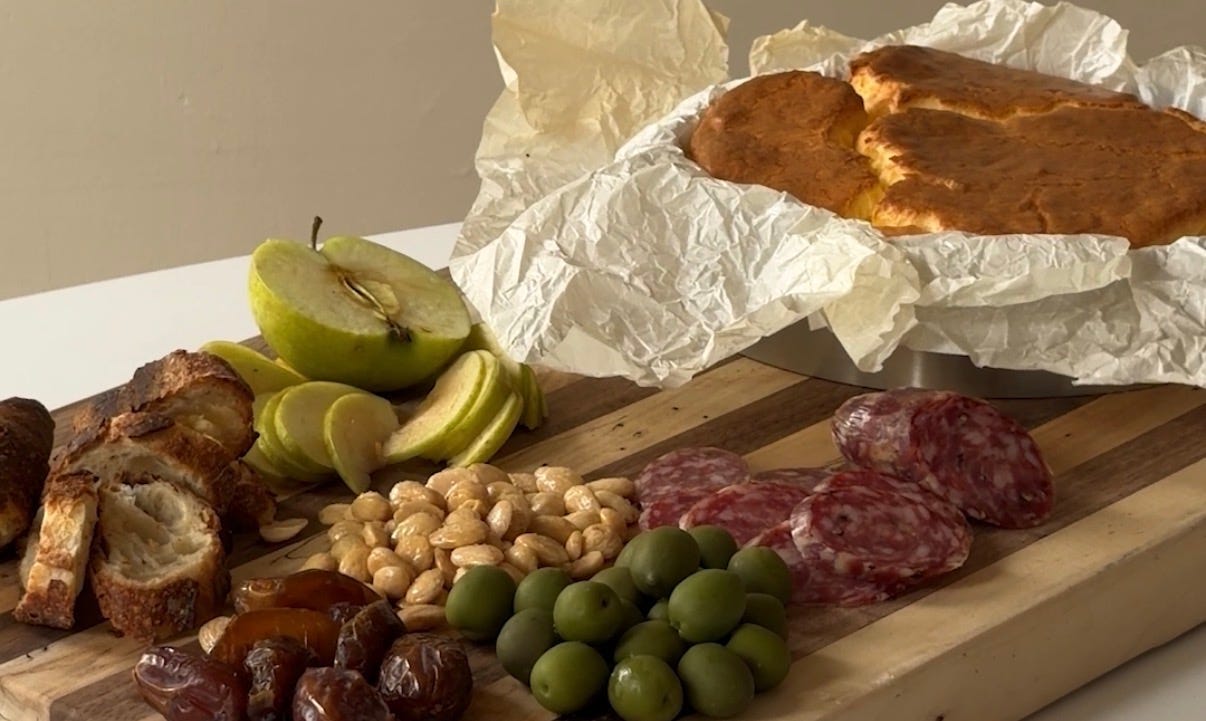
I was unable to resist taking one bite after another. I was reminded of the last time I was this head over heels for a wheel of cheese, during my cheese-baked-in-puff-pastry phase (I spoke about this extensively back in December), and I realized how great the soufflé when served with cheese board accompaniments. So I plated it up like a giant melty wheel of baked cheese alongside apple (this is a delicious pairing with the strong flavors of gruyère/comté), toasted baguette, saucisson, almonds, dates, and olives. Théo especially enjoyed making little ‘sandwiches’ with a slice of bread on the bottom and saucisson on top – which just gave me an idea for a future variation… Stay tuned!
P.S. Leftover soufflé reheats beautifully in the oven, and is especially delicious with a ratatouille (in case you still have some from that big batch ratatouille recipe from September)!
Makes 4 smaller cheesy soufflés or 1 large cheesy soufflé
Cheese Soufflé:
25g+ finely grated parm for dusting the ramekin(s)/baking dish
140g milk
15g butter + more for dusting the ramekin(s)/baking dish
18g flour
75g comté or gruyère
1/2 tsp Diamond Crystal kosher salt
Some cracks of Black pepper; a 1/2 tsp of mustard; a dash of nutmeg, cayenne, or paprika optional flavoring (you can add as many or as few as you desire)
35g egg yolks (from ~2 large eggs)
1/8 tsp white vinegar
105g egg whites
5g cornstarch
Tools:
Parchment paper
4 8oz ramekins or 1 quart soufflé dish or 1 9” cake pan
Hand mixer or stand mixer
Cheese grater/microplane
You can find ingredient information and tips for conversions on my conversion cheat-sheet page. If you have any further questions, please feel free to leave a comment!
Prep!
Preheat your oven to 400f, and place an oven rack on the lowest rung, leaving ample room on top for the soufflé. Take a baking sheet and place it in the lower rack of your oven.
Standard presentation in ramekins or a cake pan: Butter the sides (I use a butter wrapper for ease, but the traditional recipes would have you brush melted butter in an upwards motion) and then add grated parm, turning to coat all sides and letting the remainder fall to the bottom. Set the ramekins or cake pan aside, in a cool place, so the butter doesn’t melt while you prepare the soufflé.
If you are using a cake pan and want to do the same presentation as I did: Grab 2 pieces of parchment paper the length of a sheet tray. Crumple them up, unfurl them, and repeat this process 3 times. Unfurl and lay the pieces of parchment side-by-side in your cake pan, overlapping by about 2”. Push the paper into the bottom and sides of the pan first, and then fit it around the outside. Feel free to sprinkle the grated parm over the bottom of the pan. Set aside.
Cheese Soufflé!
Start with the béchamel. Warm your milk (I microwaved mine for 45 seconds), set aside, near your stove. Take a small to medium-sized pot and add your butter and flour. Place it on the stove over medium heat and whisk constantly for about 90 seconds until the roux is bubbling away and you notice the mixture expanding. Pour ~1/3rd of the milk into the roux and quickly whisk to combine. It will bubble and thicken. Immediately add another ~1/3rd, whisk to combine, and get rid of any lumps. Once it starts bubbling, whisk in the final ~1/3rd. Whisk constantly until the roux returns to a boil.
Remove from the heat and pour into a medium-sized mixing bowl. Add your salt and any of your optional flavorings. Grate your cheese into the béchamel (I like using a microplane). Whisk to combine. Then crack in your 2 egg yolks (be sure to set the whites aside) and whisk to combine. Set aside somewhere cool.
Next, whip the egg whites. Add 105-110g of egg whites to a medium-sized bowl, or the bowl of your stand mixer, along with the vinegar. Grab your stand mixer or hand mixer and mix the eggs at the lowest setting for 20 seconds. Then go up a level and mix for another 20 seconds. Keep repeating until you have soft peaks, then begin to add in the cornstarch as you continue to increase the speed. Whip until you get stiff peaks – when you lift the beaters, they should hold a peak at the beginning before curving at the tip (I rather you slightly underwhip here than overwhip). Once you’ve reached this point, the egg whites are ready.
Take your béchamel base, and make sure it is no longer hot. Add ~1/4th of the whipped egg whites and gently whisk to combine. Then add the lightened bechamel to the rest of the whipped egg whites and gently fold to combine. Pour into your baking dish(es) of choice, set on a baking sheet, and transfer to the sheet tray on the lower rack in your oven to bake. Immediately turn the oven down to 375f if baking in a large dish (if baking in ramekins, keep the heat at 400f).
Baking times:
9” cake pan = 23-25 minutes
1 quart souffle dish = 28-30 minutes
4 8 oz ramekins = 20-22 minutes
While that bakes, prepare your cheese board accompaniments (if that’s how you plan to serve the soufflé). Again, I love apple slices, toasted baguette, saucisson, almonds, dates, and/or olives, but you can add whatever you fancy! If you want to serve it the way I did, just arrange all your cheese board items on one end of a large cutting board so that as soon as the cheese soufflé comes out of the oven, you can slide it on over to the other side. I also suggest serving the soufflé with a big spoon, individual plates, and knives so your guests can grab a scoop of the soufflé and pair it with their favorite accompaniments.
Once your timer goes off, remove from the oven, immediately serve alongside your ‘cheese board’, and enjoy! Reminder that any leftovers will be delicious! Just hold them in the fridge, and re-heat in a 350f oven. The soufflé will re-puff a bit and get nice and crispy edges.
The full soufflé series:


More soufflé content:

