


In the first soufflé-themed Baking Blocks, we tackled the proper technique for whipping egg whites for soufflés. Now it’s time to master another skill, so we can get even more creative. The first recipe in the series is for a Salzburger Nockerl made very simply with egg yolks folded into whipped whites, followed by a little starch. These soufflés, however, use a custard for their base. Not only does this change the structure from less marshmallowy and cake-like to more gooey and airy, but it also means we get to flavor the soufflé itself (instead of just relying on the sauces it’s served with).
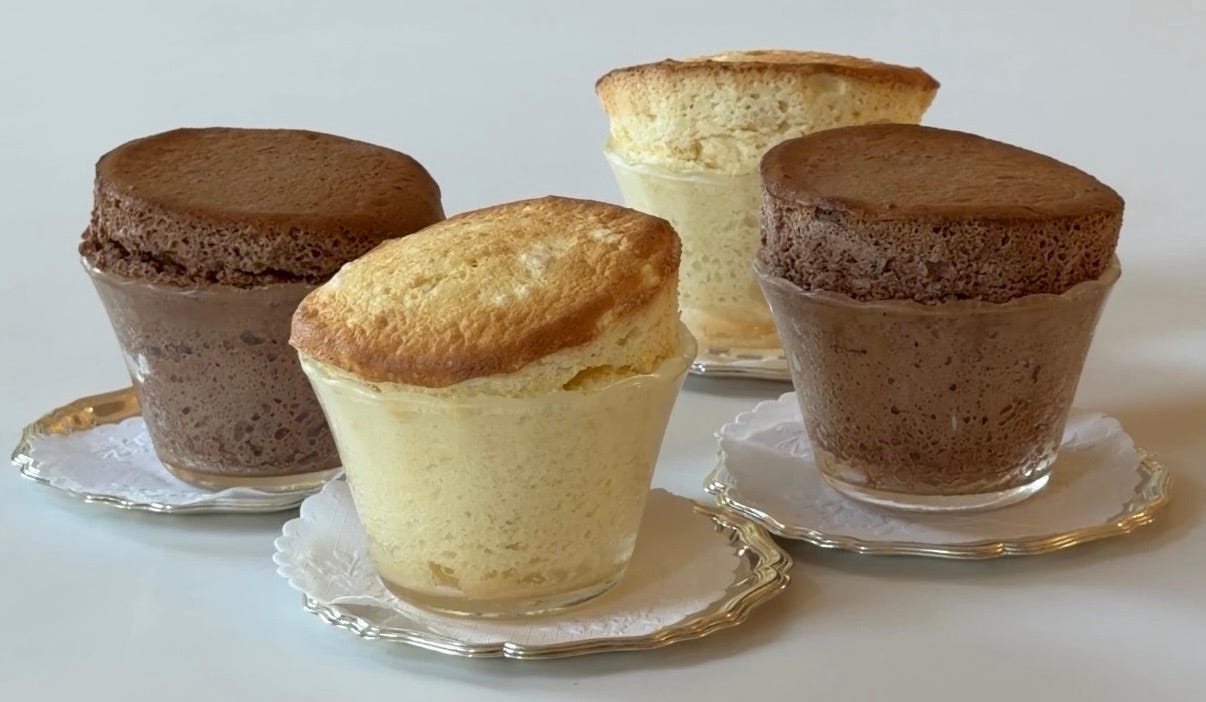
Today’s recipe starts with two soufflé basics: chocolate and vanilla. Basic, yes, but so so delicious. The chocolate is rich while staying oh-so-light and melting on the tongue. The vanilla is subtler, but just as delicious. You can also easily swap some of the vanilla extract for another extract or essence for additional flavoring (almond, pandan, orange blossom, rose, etc.). In next week’s Bake and Create, we will be adding infusions – stay tuned!
For today, all that’s required is techniques from my pudding series (i.e., custard making) and from Baking Blocks: Soufflé Pt. 1 (i.e., whipping egg whites) to make 2 delicious soufflés. I loved plating them up in dessert ramekins, which I sourced via eBay and Etsy. If you like this style, try searching “glass dessert ramekins” and look out for ones made by oven-safe glass brands or with oven-safe labeling.


P.S. Sorry this recipe is coming a day late! Getting the vanilla recipe just right took some extra time, but we sooooo got there (see video below).
Makes 4 4.5oz soufflés or 3 7oz soufflés (vanilla quantity may be a tiny bit short for the 7oz soufflés…)
Vanilla Soufflé:
Butter and sugar for the ramekins
Custard:
115g milk
11g cornstarch
3g all-purpose flour
10g sugar
35g egg yolks (from approximately 2 large eggs)
6g butter
15g vanilla extract
Egg whites:
50g white sugar or superfine sugar
120g egg whites (from approximately 4 large eggs) room temperature
1/4tsp Diamond Crystal Kosher Salt
1/2tsp white vinegar
Chocolate Soufflé:
Butter and sugar for the ramekins
Custard:
175g milk
17g cocoa powder (preferably Dutch-process)
5g cornstarch
35g egg yolks (from approximately 2 large eggs)
60g dark chocolate (I used 64% cocoa)
Egg whites:
40g white sugar or superfine sugar
120g egg whites (from approximately 4 large eggs) room temperature
1/4tsp Diamond Crystal Kosher Salt
1/2tsp white vinegar
Tools:
Hand mixer or stand mixer
Ramekins for baking (mine were 4.5 oz and 7 oz – you could also bake the soufflé in a singular large ramekin, but it will change the bake temperature and time)
You can find ingredient information and tips for conversions on my conversion cheat-sheet page. If you have any further questions, please feel free to leave a comment!
Prep!
Preheat your oven to 400f, and place an oven rack on the lowest rung, leaving ample room on top for the soufflé. Take a baking sheet and place it in the lower rack of your oven. Grab a small baking tray or cake pan (8x8 or 9x9), fill it with 3 cups of water, and place it at the bottom of your oven. This will add steam, leading to a more even cook on the soufflé.
Take your ramekins and butter the sides (I use a butter wrapper). Then add some sugar and turn the cup to coat all of the sides. Tap out any excess. Set the ramekins aside in a cool place so the butter doesn’t melt while you prepare the soufflé.
Thickened Base/Custard!
If you are making the vanilla version:
Place your milk in a medium-sized pot and set it over medium heat on the stove. While that warms, grab a medium-sized mixing bowl and add your cornstarch, flour, and sugar. Whisk to combine. Then add in your egg yolks (reserve the whites for the soufflé) and whisk again to thoroughly combine.
If you are making the chocolate version:
Place your milk in a medium-sized pot and set it over medium heat on the stove. While that warms, grab a medium-sized mixing bowl and add your cornstarch and cocoa powder. Whisk to combine. Then add in your egg yolks (reserve the whites for the soufflé) and a little bit (approximately 2 tbsp) of the warming milk. Whisk again to thoroughly combine.
At this point, the milk should be steaming. Slowly pour in a stream of milk while whisking the yolks to temper. Once you’ve added about 2/3rds of the milk, pour the egg/milk mixture back into the pot, and use a soft spatula to add every last bit of egg mixture from the bowl. Set the bowl aside and return to the stove. Continue whisking over medium heat until it thickens into a homogenous paste.
Remove from the heat and scoop the cooked custard back into the bowl that we whisked our egg yolks in.
If you are making the vanilla version, add your butter and vanilla extract.
If you are making the chocolate version, add your chocolate.
Whisk to melt and combine. Cover the top of the custard directly with cling film and set aside somewhere cool while you prepare the egg whites.
Egg Whites!
Grab the sugar for the soufflé and blend in a blender or spice grinder until super fine (skip this step if you are using superfine sugar). In a large mixing bowl, add the egg whites, salt, and vinegar. Grab your stand mixer and mix the eggs at the lowest setting for 30 seconds. Then go up a level and mix for another 30 seconds. Then up another level and mix for another 30 seconds. At this point, the eggs should be very frothy. Add about 1/5th of the sugar and slowly increase the speed of your hand mixer. Continue to add the rest of the sugar about 1/5th at a time while continuing to increase the speed about every 30 seconds). Slowly increasing the speed like this leads to a more stable egg white. Your soufflé will thus be stronger when you go to fold in your custard.
Once you are done adding all of your sugar, you should be on the highest setting of your hand mixer, and you should have stiff peaks (you may need to mix for a bit longer than the last 30 seconds of whipping the last 1/5th of sugar). The egg whites are properly whipped when they are shiny, have tiny and uniform air bubbles, and there is a sudden shift in texture. It should seem thicker/stiffer, and when you lift the beaters out, it should hold a tall peak (curving just at the tip) and not slump over immediately. Once you’ve noticed all of this, your egg whites are done. Do not continue, or you risk over-whipping them. When over-whipped, they will lose their shine, becoming cloudy and cottage cheese-like. Please refer to the video in Baking Blocks Pt. 1 for a visual of properly whipped whites!
Assembly + Bake!
Remove the cling film from the custard and check the temperature, it’s totally fine if it’s a little warm, but should no longer be hot. Using those same beaters with a little meringue left on them, mix the custard. Mix the custard with the beaters until it has smoothed out – this is very important (and easier than using a whisk to smooth).
Add 1/4th of the whipped egg whites to the custard, and gently whisk to incorporate and loosen it further. Then add the loosened/lightened custard to the bowl of the remaining egg whites and fold until combined. You may notice some lumps of custard; don’t worry about getting these out, you won’t notice them in the final product, and you need to keep the air!
Place your butter and sugar-lined ramekins on a baking sheet lined with parchment paper. Gently scoop the soufflé batter into each ramekin, up to the rim. Level the top with an offset spatula. Run your thumb along the top inner rim of the ramekin, creating a little trench to help release the soufflé (otherwise it will stick and lead to an uneven top). See the video above for a visual!
Transfer to the oven, placing the baking sheet of ramekins on top of the pre-warmed baking sheet (this helps with rise). Close the oven door and decrease the oven to 375f. Set a timer for 12-13 minutes for 4-5 oz ramekins or 15-16 minutes for 6-7 oz ramekins.
While the soufflés bake, this is a great time to clean your dishes and prepare your serving plates.
When done, the soufflés will have risen significantly with a set and puffed outer top ring. Transfer the soufflés to your serving plates and enjoy immediately! While this soufflé is less temperamental than the Salzburger, it is still best enjoyed straight out of the oven.
Check out the whole soufflé series:


